Technology provides huge potential for courts to improve their processes, efficiency, and accessibility to the public. But, a bunch of rogue technology solutions without a clear plan on how they work together creates silos, which can cause more harm than good.
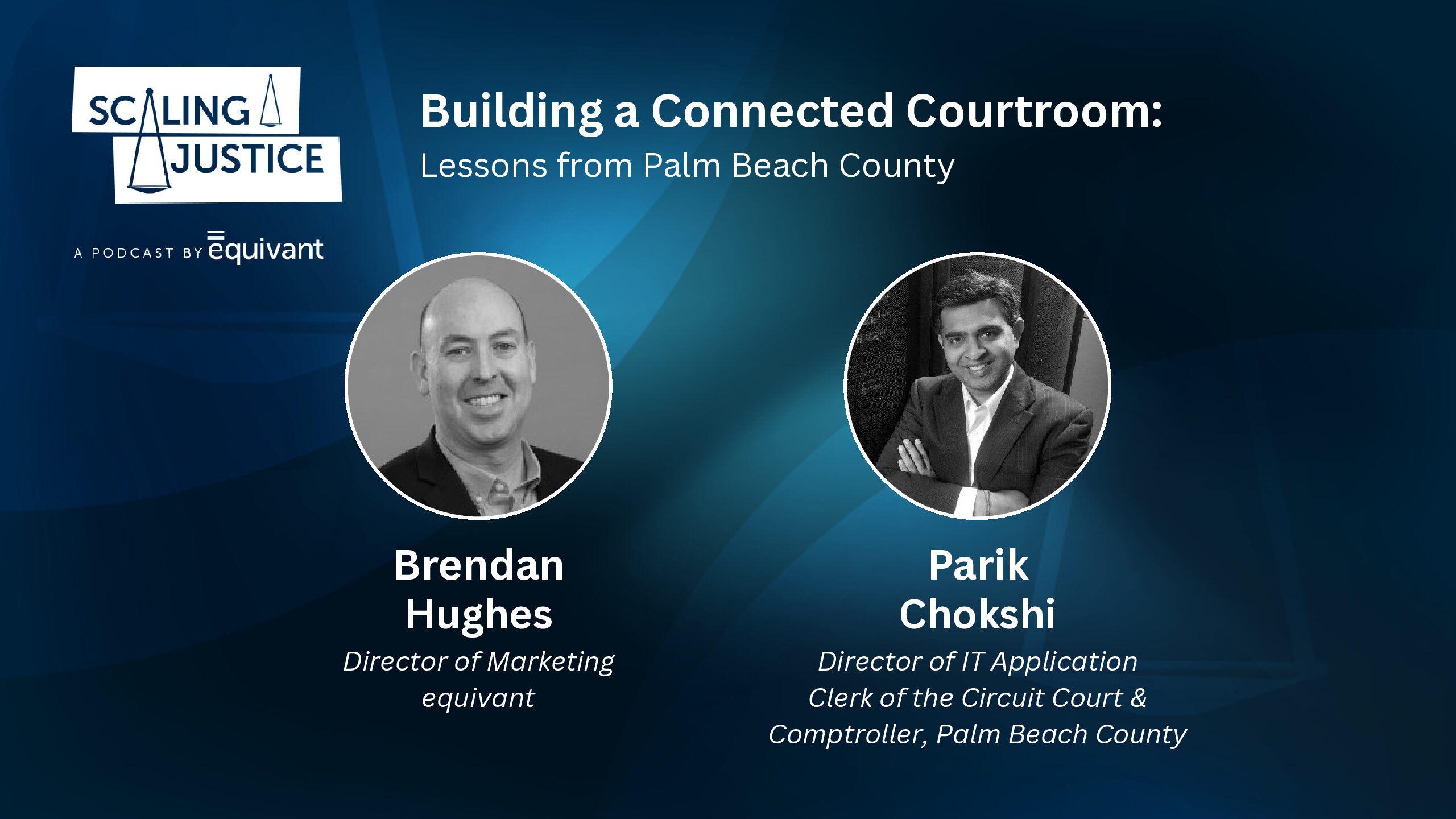
In this episode, we talk with Parik Chokshi from Palm Beach County to understand how his court has approached implementing technology solutions and how they have created a unified ecosystem that works for their staff and public.
Watch the video podcast on YouTube down below, or stream the audio version on Simplecast.
Watch on YouTube:
Stream Audio Version on Simplecast:
Podcast Transcript
Brendan Hughes: Hello. Welcome to Scaling Justice, a video podcast by equivant that operates at the forefront of the justice space. I’m Brendan Hughes, Marketing Director at equivant.
All of us at equivant are dedicated to delivering innovative solutions to simplify justice.
Today’s episode of Scaling Justice is focused on an emerging topic among court technology leaders. In the past and even today, the underlying technology that runs a court is based on a single system, often a case management solution, and for a lot of courts, that system often is still siloed from other systems.
The result can be challenges to court workflows and processes, and general efficiency. An alternative is to build a truly connected ecosystem of technology solutions that really talk to each other and drive efficiency rather than impede it. Sounds great in theory but in reality, creating a connected ecosystem is an ambitious goal.
Luckily for us, we have a guest today who is passionate about this concept and ready to talk it through. So let’s jump into it and welcome our special guest, Parik Chokshi, director of IT for Palm Beach County, Florida.
Parik Chokshi: Hi, Brendan. Yeah, my name is Parik Chokshi. I’m the IT director for the Palm Beach County Clerk’s and Comptroller’s office.
Been here 20 years. I started as a IT specialist in 2006 and I have been here since. I’ve seen the documents go from paper to digital so been here for a very long time.
Brendan Hughes: Great. Yeah. Appreciate you joining us today. You have a very experienced background, and I know this is a topic that you’re passionate about, as I mentioned at the opening.
Maybe let’s get right into it. You’ve seen traditionally that the case management system has been kind of the driver, and now you’re feeling like there’s a shift with vendors, with other court leaders where the case management system is just one part of an ecosystem. So from your perspective, what’s driving that shift? What does it look like from your perspective?
Parik Chokshi: Yeah so, uh, Palm Beach County population currently stands at around 1.6 million, and it’s been growing year on year. So when I first started in 2006, we were getting all of our documents and filings through paper, and through technology, we have evolved over the course of last 20 years, where we’ve seen the shift where we’re going from paper to digital.
Today we’re seeing per year e-filings coming into our office or, is around 2.5 million. Seeing almost 40 to 40,000 45,000 documents per week going through our systems. So as population is increasing and technology is evolving, a lot of users are now using tools to send us documents or through the e-filing portal or whatever.
So we are receiving those e-filings and processing those e-filings. But the courts is just not comprised of just a CMS. We also manage and maintain jury office. We also manage and maintain our evidence system. We also manage and maintain our document processing system. And on top of that, we continue to provide support for our justice partners, providing them data and information including the judges.
So over the course we’ve always had systems where they were like siloed. Mm-hmm. So jury system, system was sitting separately from our CMS, and then our evidence management system was sitting separately, our document management was sitting separately, and then our APIs or integration with other justice partners were sitting separately.
So what we’re seeing is a huge trend in the courts ecosystem where everything is converging and coming into one ecosystem- where the CMS not only just handles CMS, but it integrates with multiple multitude of systems, so we can run workflows and add efficiencies through the process.
Brendan Hughes: Yeah. And I imagine with all those different systems and then the increasing volume you were just referencing, that if the systems stay siloed, that could really impact the day-to-day operations, like the time the clerks have to work on things, staff data quality, and then it probably impacts the public’s experience as well.
How do you see that impacting your day-to-day court?
Parik Chokshi: Yeah. For example, for our jury system, if we entered a case in our CMS, we would have to enter the same case number or party information in our jury system, evidence system, and multiple other systems.
So there was a lot of redundant data entry happening. So having one ecosystem, the way we can build data accuracy is whatever’s in the CMS can feed into other systems and maintain data integrity across all systems. So that’s one of the, the benefits of having a one ecosystem where all courts work with all, not just CMS, but all applications combined that comprises of a court system,
Brendan Hughes: That’s a great example.
And I know something that you had mentioned to me in prior interactions that we’ve had is the scenarios with courtroom transcription and how important that is and how valuable that could be to a, a system where it’s all connected. Can you maybe walk me through a little bit about how important the courtroom transcription is to the process?
Parik Chokshi: So we’ve over the last, I think, eight years we’ve implemented something called in-court processing. Prior to in-court processing, what used to happen is we used to have clerks inside the courtroom write down all the all the information from the judges on a court event form, and then that sheet of paper would travel back from the courtroom to the back-end office, and then the clerk would be responsible for putting all that information into the CMS.
Sometimes a case that was heard at 9:00 in the morning would not get updated in the CMS till 4:00, 5:00 in the afternoon. So by implementing ICP, what we did is we took we took, we brought ICP into the courtroom, where the clerk can sit inside the courtroom, and as the judge is going over the processing the case, we can in real time update the case and add necessary documents so the information was available very quickly.
Not only to the judges, but to the public, to, to the attorneys, to all the justice partners. They would get the information very quickly. And as you’re aware, in traffic moves really fast in our courtrooms. So at currently in our courtrooms, we have two clerks sitting in the courtroom with two computers.
They’re switching back and forth and going over cases and entering all the information from the judges manually in live court, which is very time-consuming. So what my idea, or the idea, is if you had court transcription assist in-court processing so as the judge is uttering information ICP gets updates from the transcription that’s happening, and the clerk gets to see the real-time summary, and then they just get to approve what the judge mentioned in the courtroom or get a chance to correct something and hit a button where it would actually hit the case very quickly.
And now the, the clerks do not have to remember every single button, every single prompt that they had to plug in manually. ‘Cause it does take, in today’s world, in order for us to put a clerk inside the courtroom, it takes up to a year of training for them.
Brendan Hughes: Wow.
Parik Chokshi: And they have to sit with somebody throughout the courtroom before they get to be in a live courtroom by themselves.
A transcription solution that talks to ICP in court processing would shorten that time for training and also make the process more efficient.
Brendan Hughes: Yeah, I could see the benefits of that system immediately as an impact for your efficiency across the board. And it seems like it’s an opportunity for, some new tools that might be automated based or even AI based.
Is that something that you see as a potential solution?
Parik Chokshi: Yeah, I think as AI is evolving and we’re seeing that in Claude, ChatGPT, and all the- these different Grok bots and all these different solutions coming out the future is where we are gonna see agents built into the CMS that will help with current case processing.
Again, we have to make sure we have safeguards and security in place so that they don’t just run by themselves. There’s gotta be an oversight of what the bot is doing, and anything that requires or deals with anything sensitive has to be a, a, a human in the loop or a human that actually verifies the information before it goes into the CMS or any other system.
So agents are the future where we see the CMS going, moving towards.
Brendan Hughes: Yeah, that makes a lot of sense, and I like the way you mentioned about as the, the AI becomes more adopted technology, that there’s still that need for the human oversight especially in, in a, a public sector that you are in.
And then having all these systems exchanging data within your potential ecosystem, trusting the technology and the accuracy you’re thinking that you still need that human oversight.
Parik Chokshi: Correct. And as I mentioned earlier, our population is going up, and our year-to-year, our filings that we’re receiving is the volume is going up.
And unfortunately, our budget is shrinking, so we have to figure out a different way to become more efficient and have the proper tools in hand to process the enormous amount of volume that is coming to us and to the courts.
So I think that’s where the next evolution of technology is heading towards is having AI agents, not just one agent working by itself, but multitude of agents talking to each other across multiple systems and handling our day-to-day workflow, our business workflow.
Again, there’s gotta be an AI governance, an AI oversight where we know which, which task can be performed by an agent without a human oversight, or which task can be involved where AI, there is a human oversight. And some tasks may be targeted for, hey, there’s no AI, we cannot have AI do anything, it’s a manual task, because we wanna be risk adverse and not introduce more risk to our, to any of, any systems.
Brendan Hughes: Yeah, that makes a lot of sense. And if we’re taking a little bit of a step back now, if you’re a court leader like yourself the idea of these ecosystem, a bigger ecosystem all talking to each other more efficiently it probably makes you want to evaluate new technology in, maybe in a different way.
For court leaders, what questions should they be asking for new tools or technologies or new ways of doing things, how they will fit into their ecosystem?
Parik Chokshi: I think each product needs to be evaluated and the word AI is being used everywhere. I think every product you look at online, they mention some sort of AI, they have some sort of AI.
So I think some important questions that need to be answered is, first of all internally we’ve generated a questionnaire, AI questionnaire, that we submit to any vendor and say, “Here’s the questionnaire you need to answer.” It answers questions regarding security, authentication how often, what other court systems they’re involved with, who their current partners are, and they have to go through proper checks and balance before they become validated for us to even look at as an option for a solution or an efficiency.
We also are working with vendors, because now what is, what we’re, the one of the things we’re noticing is the vendors are now saying, “Hey, we’re h- we have our own cloud supported solution, a SAS solution,” where all the customers have to move towards. So now if the CMSs and the evidence and document management system move to the cloud, how do those systems talk to each other if they’re in different clouds?
So again, there is a sense of security that needs to be addressed, and each tool should be evaluated on how it’s gonna function to be incorporated in production.
Also one of the big factors to to include is testing. A, a lot of time vendors might say, “Hey I have a tool that can work for you.”
I would say, “Test it first. Make sure it runs in your QA environment. You go through proper text checks and balance and approval before you move it into production,” because you don’t want, the last thing you want is a rogue AI system running in your environment
Brendan Hughes: Yeah. And just hearing you talk about all the different possibilities and the things that you need to be aware of when evaluating vendors and the different segments that they come from, and then having them all connect together that’s a lot of planning and foresight on your behalf.
Is there something you would say to court leaders about how you would plan ahead for this? Because it, it does seem to take a lot of coordination and forethought.
Parik Chokshi: Absolutely Brendan. What ends up happening is a lot of executives or the stakeholders say, “Hey, this is AI, it’s all solely driven by IT.”
And no project is solely driven by IT. I think this is an organizational effort to implement any AI tool within your organization. It’s not just not IT, but operations legal. Everybody has to come together to understand the requirements. What problems are they trying to solve? Because AI is not always the best solution.
You have to figure out how much savings, whether it be cost savings, whether it be human effort savings, FTE savings, what is the outcome of the tool that you’re trying to implement? Because the last thing you want to do is create more effort, which requires more time and more human intervention, and now actually you’ve just expanded your project into being more costly and not being efficient at all for the organization.
Brendan Hughes: Yeah, and looking ahead three to five years, what do you think a connected courtroom a connected ecosystem of technology, what do you think that looks like?
Parik Chokshi: Hollywood has portrayed this pretty… There was a recent movie where AI is the judge doing sentencing on the defendant. I don’t think we’re gonna go that far. AI is, again, a tool to make your processes efficient.
We live in a world where everybody wants information very quickly. They don’t wanna wait. So identifying which business processes are required in order to process the caseload and process, process the volume of documents we’re receiving efficiently and getting it in front of the right people is the key.
Because even waiting 5, 10 minutes nowadays seems forever. So that’s what needs to happen. AI is definitely going to process work and send information from one system to another system and make that data accessible by the right people.
And not just the data. I think AI’s gonna help us figure out where the hurdles are, what cases are taking longer to process versus which ones are being processes, processed quickly.
We can create KPIs and information through AI rather than having a report writer build those KPI dashboards. So AI’s gonna help us in reporting as well.
Brendan Hughes: That’s great. And, if we were to, I know you’ve given a few tips already, but if we were to leave people with, one or two things that, that they should be doing today to, to prepare themselves for this, feature and trying to make their courts m- more modern, what are those things that you would suggest they do?
Parik Chokshi: I think the first and foremost is talking to your vendors. What is their, what do their future roadmap look like for their product, their vision, what that is? Beause one thing you don’t want to do is implement AI on-prem, and then the vendor comes around and tells you, “Hey, we’re moving to the cloud, and you need to go to the cloud.”
Now, the effort and energy you spent on implementing AI on-prem, now you have to figure out how to run it in the vendor cloud, which becomes more difficult. So talking to different vendors, figuring out what their future roadmap is, and then working with them to figure out which AI toolsets you wanna implement, and then they, the vendors might give you guidance on, “Hey, we have something that is coming down the pipeline that’s gonna help you with that,” or, “No, we can, we don’t have anything like that in mind, but you can look at options and then come to us and we’ll figure out whether way, we can in- entertain those pro those products or tools or options so that we can move forward.”
But I think communication is the big key not just within talking to your vendors, but communicating within your organization talking to your operational folks, talking to the public, talking to different justice partners to see how we can do our work better, rather than working in silos.
That’s going to be a key is communication to me.
Brendan Hughes: A lot of great stuff today. I think anybody listening will pull out at least two or three things that will get them thinking about the future and working towards less silos, more connected ecosystem. I appreciate you joining us today, Parik.
Parik Chokshi: Thank you, Brendan. Loved to be here.
Brendan Hughes: Great, and that is our latest episode of Scaling Justice.