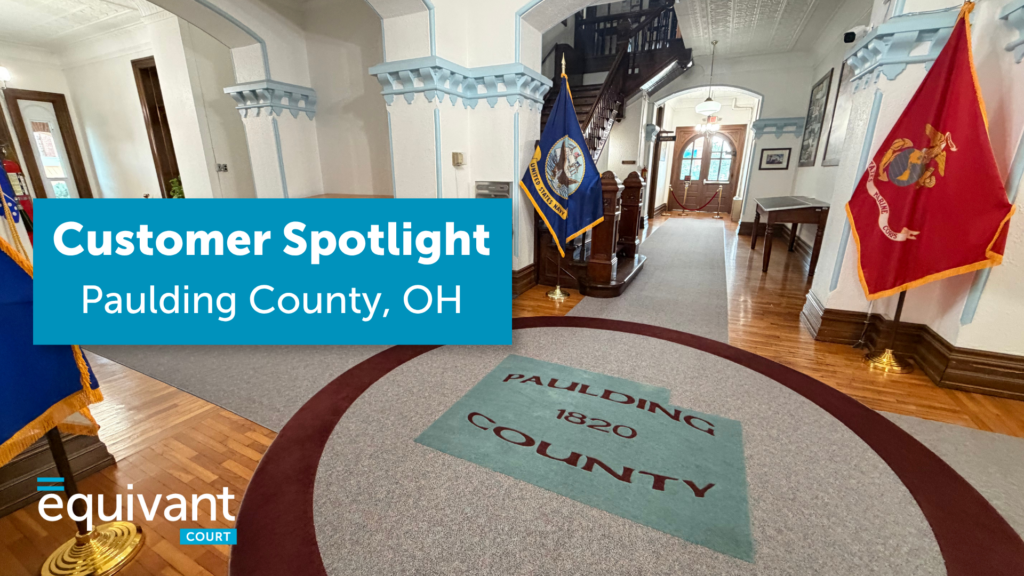
Paulding County Common Pleas Court isn’t a large court by any measure. It serves a community of about 18,700 people, runs on a lean staff of just two deputies along with a working Clerk of Courts, and operates out of a historic courthouse building that comes with its own set of constraints — any renovation has to work within a layout that’s been there for generations. The court handles a modest but steady docket each month including a handful of domestic cases, around a dozen criminal filings, and a similar number of civil matters. On top of all that, the office also runs the county’s title division out of a separate location and issues passports and passport photos.
In other words, Paulding runs tight. There isn’t a large team to absorb a rocky technology transition, and there isn’t room in the budget for false starts. So, when the court decided it was time to move off its legacy case management system, the stakes were different than they might be for a bigger jurisdiction, but the payoff mattered just as much.
Why Change Was Necessary: Legislative Mandates and Grant Funding
Like a lot of smaller courts, Paulding was working against two pressures at once. Being a small office means fewer hands to manage a technology transition, and funding for court technology is never unlimited. Meanwhile, the court’s aging legacy system was becoming a liability in its own right.
The push to modernize came into focus when the State of Ohio introduced e-filing requirements, and Paulding secured grant funding earmarked for a technology upgrade. That combination of a state-level push toward e-filing and dedicated funding to act on it gave the court a real opportunity to make a move. equivant Court’s CourtView 3 stood out because it fit both what the court needed operationally and what its budget allowed.
A Migration Built Around Flexibility
Planning for the transition began the previous year, but the project truly got underway in January 2026, with the equivant team on-site by February and March to get things moving. Staff training started in May, and the court had its sights set on a go-live by the end of July.
Paulding’s team credits much of the project’s success to how the equivant team worked with them along the way. Weekly check-ins with Senior Project Manager Aaron Spatz kept the project on track even when circumstances required flexibility. Paulding’s staff say that flexibility, paired with steady communication, made all the difference in hitting the deadline. Alongside Aaron, the equivant team, Jamie Vogel, Jacy Hose-Frey, Emily Harvey, Katie Brachel, and Michael Peceny, brought the expertise and hands-on support that kept the project moving.
The Paulding team was quick to point out the people behind the project. Senior Project Manager Aaron earned praise for his understanding and adaptability throughout. And Jamie, who brought her own prior court experience to the engagement, made enough of an impression that one Paulding staff member joked, “Can I just hire you?” — a nod to how much her firsthand perspective helped translate the court’s day-to-day needs into the new system.
Just as important was the commitment on Paulding’s side. Clerk of Courts Sarah Harpel led the charge, supported by Deputy Clerk Kacey Dershem and Monica McKinley. Court Administrator/Criminal Coordinator Melissa Daeger and Civil and Domestic Coordinator Sarah McCabe helped guide staff through the transition day to day, while Judge Beckman and Magistrate Kight’s support from the bench helped set the tone for the project’s success.
What’s Better Since Going Live: Faster System, Less Reliance on Paper Files
Since moving to CourtView 3, Paulding’s staff point to a handful of changes that have made a real difference in day-to-day work. Something as simple as printing envelopes (a small task, but one that adds up over a busy week) has gotten noticeably easier. The system itself feels faster overall, particularly with cases involving multiple witnesses, where the previous system tended to slow down.
Being web-based has also been a welcome shift. And one feature in particular stood out to the team: the ability to overlap with the index, something their previous CourtView version didn’t offer.
“All in all, it has been great. I love how fast it is,” Sarah Harpel, Clerk of Courts said. “I love that it is web-based.”
Looking ahead, Paulding is hoping technology continues to help the court reduce its reliance on paper files, a natural next step as the office settles into its new system.
Advice for Other Courts
Paulding’s move wasn’t just about swapping one system for another. It was about finding a partner that understood the realities of running a small court. That perspective is exactly why their advice for other courts considering a similar transition carries so much weight:
“You need to be aware of what your court needs and does. Then, look at the products and see what meets your needs. You need to do your research.” — Sarah Harpel, Clerk of Courts
Sarah also pointed to something courts don’t always think about upfront: looking past current needs to where a product is headed. Considering a vendor’s roadmap and whether it will keep pace with evolving regulations matters just as much as what the system does today.
For a court running lean, with a historic building and a small staff wearing a lot of hats, Paulding’s experience is a reminder that modernization doesn’t require a large operation to pull off well. It just requires the right fit, and a team on the other end willing to meet you where you are.
*We value transparency. AI tools helped shape this post, but the ideas, voice, and final words are ours.*